

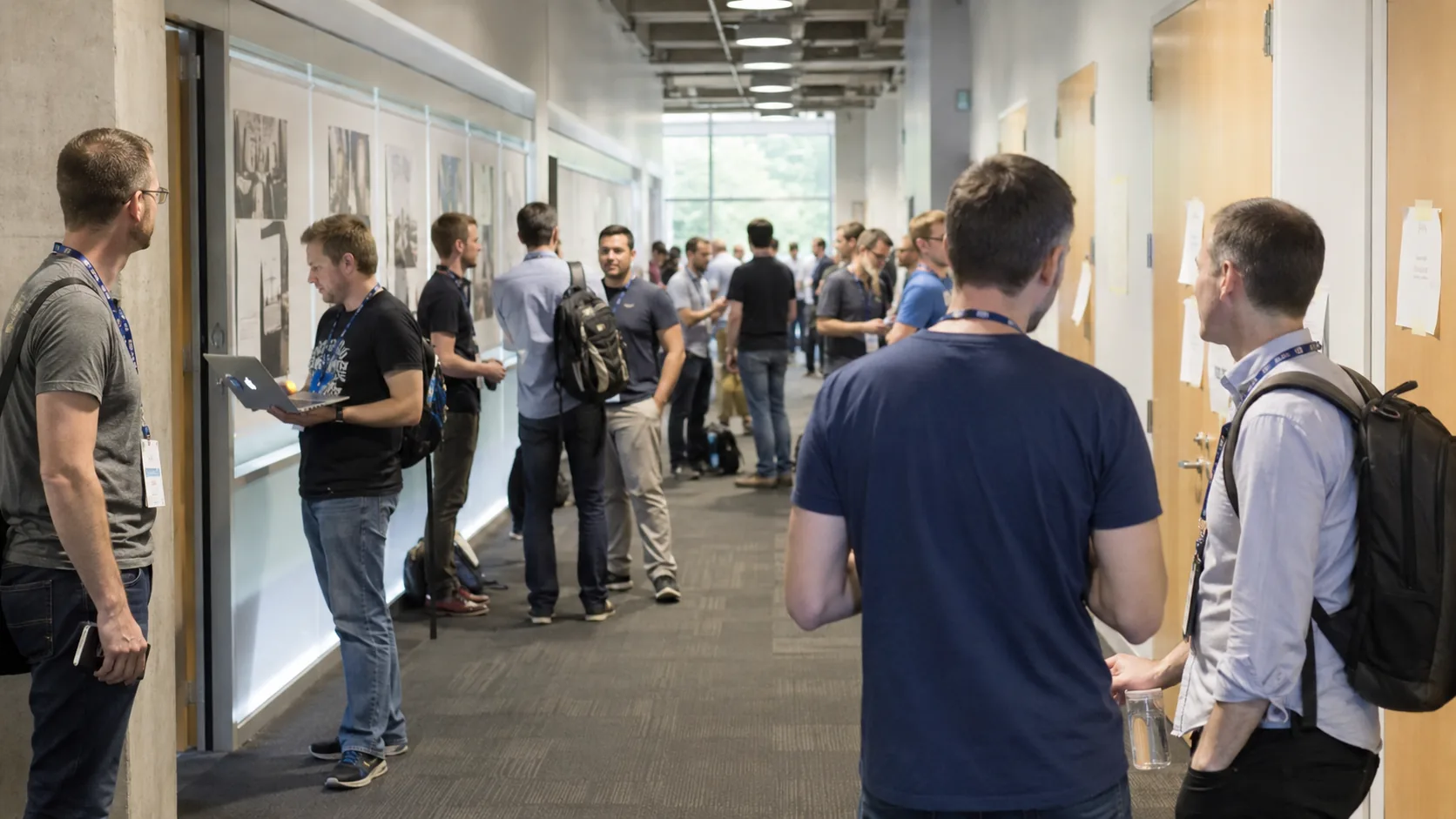
What FOSDEM Gets Right: The Case for Community Conferences
FOSDEM costs nothing to attend. It draws more than 8,000 developers to a university campus in Brussels, runs about 65 parallel developer rooms, and is put together entirely by volunteers under a Belgian non-profit. There is no registration fee, no programme committee sitting over the whole event, and no proceedings at the end of it.
By the standards of the peer-reviewed circuit this should not work. It has worked for twenty-five years.
Community conferences are a much larger share of the landscape than their reputation suggests, and for some career stages they are a better use of a week than another rejected submission. Here is what the pattern actually looks like, and where it does and does not pay off.
They are a third of the field
Of the 279 conference series we track, 99 carry no CORE rank at all. That is 35% of the list: FOSDEM, the Chaos Communication Congress, SCALE, PyCon US, EuroPython, KubeCon, DEF CON, BSides, HOPE and dozens more.
The ranked 180 break down as 59 A*, 78 A, 37 B and 6 C, and those are the venues that dominate how researchers talk about conferences. But 118 of the 279 series have no fixed submission deadline in our data at all, because they do not run a single annual call. They curate, or they accept rolling proposals, or they devolve the whole programme to the communities inside them.
That last model is FOSDEM’s. Each of the 65 devrooms runs its own call for participation on its own timetable. There is no conference-wide deadline to miss, and no single committee to get past.
The economics are not close
We worked through the real cost of attending an academic conference here: roughly $1,400 for a domestic student trip and about $3,250 for an international A* once registration, flights, six nights and food are counted. Registration alone is frequently $600 to $1,000, and the early-bird structure quietly punishes anyone waiting on a funding decision.
FOSDEM’s registration is zero. So is the Chaos Communication Congress ticket relative to an ACM member rate, and SCALE and BSides run at a fraction of a typical academic fee. The trip still costs a flight and a hotel, which is not nothing, but you have removed the single largest line item and the one that most often decides whether a student goes at all.
If your funding is thin, this is the difference between one conference a year and three.
The selectivity argument cuts both ways
We hold acceptance rates for 60 series. They run from 14.0% at IJCAI and SIGCOMM to 50.0% at Interspeech, and we made the case in the acceptance-rate analysis that the number tracks subfield rather than prestige.
A 14% venue is a genuine filter and a genuine signal. Nobody should pretend a FOSDEM devroom talk is the same line on a CV as an accepted SIGCOMM paper, and this post is not making that argument.
What it is saying is that the filter runs on a particular axis. Peer review selects for novelty and rigour as judged by other researchers. A devroom CFP selects for whether the maintainers of a project think the room wants to hear it. Those are different questions, and the second one is a lot more useful if your work has users.
What you actually get
The people who use the thing are in the room. At a ranked conference the audience is largely other authors. At FOSDEM the audience for a talk about a compiler includes people shipping code on it that afternoon. Feedback arrives faster and is less polite.
The hallway is the programme. Because there is no fee and no gatekeeping, the density of maintainers, contributors and employers is unusually high, and most people are there for the corridors as much as the talks. Everything at FOSDEM is streamed and recorded anyway, which frees the two days for the part that is not recordable.
Speaking is achievable early. Getting a first talk accepted at a devroom, a SCALE track or a BSides is realistic for a second-year PhD student in a way that a first-authored A* paper is not. It is practice at explaining your work to people who will interrupt.
What you do not get
No proceedings, in most cases. No DOI, no citation, and nothing a hiring or tenure committee counts. If your department measures output in ranked publications, a community conference is a supplement and not a substitute, and treating it otherwise will hurt you.
There is also no travel-grant infrastructure. Most of the funding programmes we catalogued attach to the academic circuit. A free conference can end up harder to fund precisely because there is no registration line to put on a claim form.
Free does not mean easy to attend
The practical trap. A free conference still has finite hotel rooms, and the ones that fill a city fill it just as hard as a paid event. FOSDEM puts several thousand people into Brussels on a fixed weekend at the turn of January into February, and the affordable rooms go months ahead. The Brussels city page has the detail, including the one local quirk worth exploiting: the EU-quarter business hotels empty out at weekends, which is exactly when conferences run there, so rates in that district drop when everything else rises.
Two more practical notes. The venue is usually not the convention centre you expect: FOSDEM is at the ULB Solbosch campus in residential Ixelles, roughly 3 km from the Grand Place, with no hotels beside it, so optimise for tram access rather than walking distance. And because devrooms run their own calls, finding the room comes before writing the abstract.
Where to start
If you want to try one, the calendar is well spread. FOSDEM in Brussels at the turn of January and February is the largest and the cheapest entry point. SCALE in Pasadena in spring and KubeCon are the North American equivalents at different scales. EuroPython and PyCon US are the language-community model. DEF CON, BSides and HOPE cover security, and we wrote about how that world splits from the academic one in the cybersecurity publishing guide. Koli Calling is the interesting hybrid: peer reviewed and ranked, but small, remote and deliberately built around discussion.
The honest summary is that the two circuits answer different questions. The ranked venues ask whether your work is new and correct. The community ones ask whether anyone wants to use it. A career that only ever answers the first question is a fragile one.