

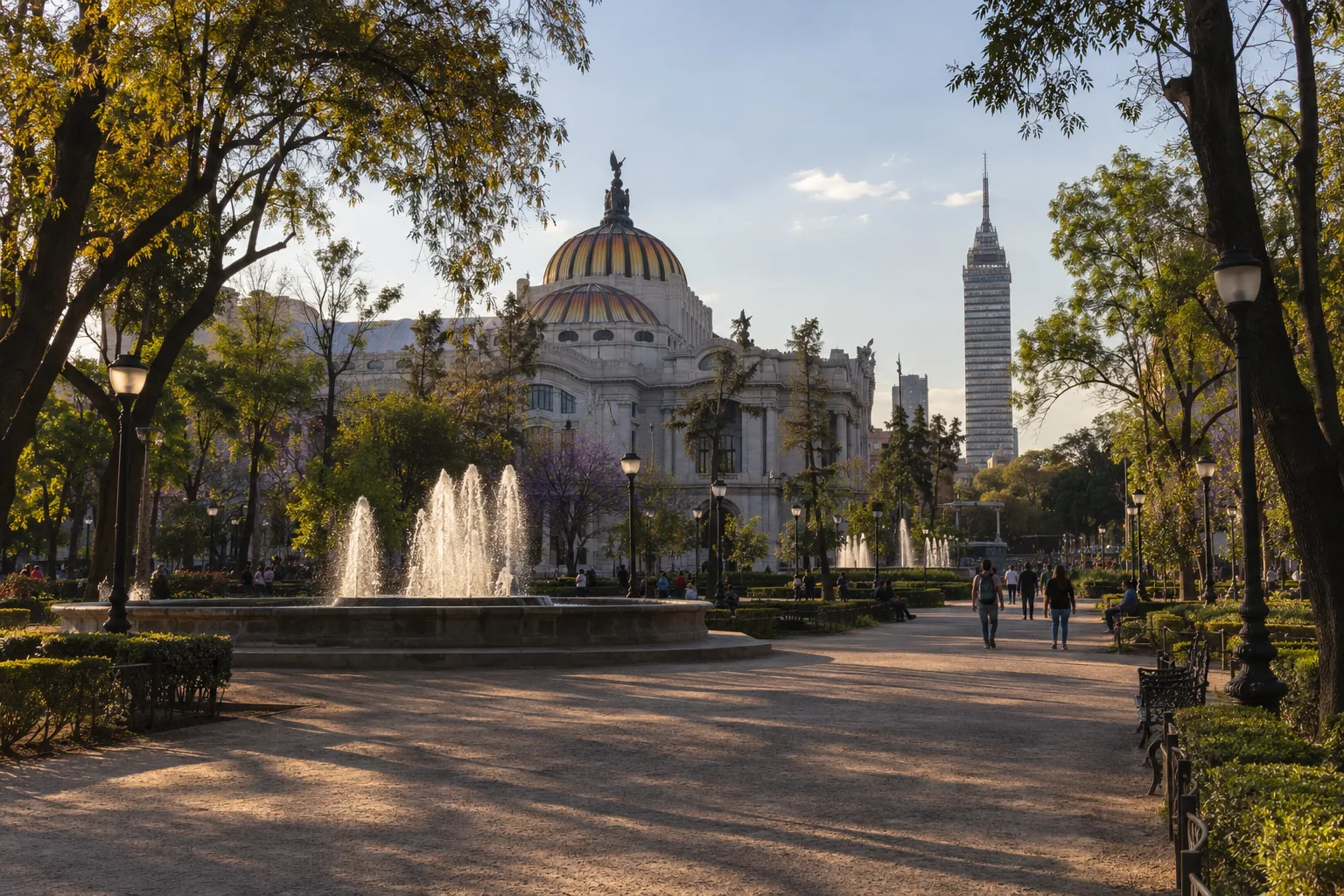
POPL 2027 in Mexico City: Where to Stay for POPL Week
- Dates: POPL week January 10 to 16, 2027. CPP and VMCAI on January 11 and 12
- Venue: Hilton Mexico City Reforma, Av. Juarez 70, facing Alameda Central
- Airport: AICM, with Metrobus Line 4 running to stops 364 m and 497 m from the venue
- Booking: Decisions land 6 to 10 November, then the holidays. Book in November
- Downtime: Bellas Artes, a Diego Rivera mural and the Zocalo, all inside a 1.5 km walk
POPL 2027 runs from 10 to 16 January 2027 at the Hilton Mexico City Reforma. CPP and VMCAI run alongside it on Monday 11 and Tuesday 12 January, in the same building, with twelve workshops spread across the week.
POPL has been running since 1973. It has met across the United States and Canada, around Europe, and once in Asia, in Mumbai in 2015. January 2027 is its first meeting in Latin America, which for much of the community means an unfamiliar city in a month they do not usually travel.
The booking window is about three weeks long
Every decision for POPL week lands inside five days:
| Event | Notification | Days before the conference |
|---|---|---|
| VMCAI 2027 | 6 November 2026 | 65 |
| POPL 2027 final acceptance | 9 November 2026 | 62 |
| CPP 2027 | 10 November 2026 | 61 |
POPL’s first-round notification went out on 5 October and the revision deadline was 26 October, but the final acceptance notice is 9 November, so a good number of authors still do not know whether they are going. Add the two co-hosted conferences and the attendee list is not settled until the second week of November.
December is the problem. From the middle of December through the first week of January, much of the world stops answering email, Mexican domestic travel peaks, and rates move with it. The Mexican holiday period runs through Día de Reyes on 6 January, four days before POPL week opens, so the domestic wave clears out just as the conference arrives.
That leaves the second half of November. Waiting until after the holidays puts you inside four weeks of travel to a city most attendees have never been to.
What POPL week covers
Three CORE-ranked conferences and twelve workshops share the building and a single registration.
| Track | Rank | When |
|---|---|---|
| POPL research papers | A* | Main track, days not yet published |
| CPP (Certified Programs and Proofs) | B | Monday 11 and Tuesday 12 January |
| VMCAI (Verification, Model Checking and Abstract Interpretation) | B | Monday 11 and Tuesday 12 January |
| PLMW @ POPL, 15th edition | Tuesday 12 January | |
| FPBT, FRIDA, LAFI, PAgE, PEPM, PLanQC, PriSC, RocqPL, TPSA, WAVE, WAW | Across the week |
The per-day schedule for the main POPL track has not been published yet. CPP, VMCAI and PLMW have published theirs, and on recent form POPL occupies the middle of the week, but the programme page is behind a sign-in and the conference has not stated the days. If you are deciding between four nights and seven, wait for the programme rather than inferring it. We will update this post when it lands.
For anyone not already accepted, the workshops are the remaining route in. As listed on the POPL 2027 site in late October: WAVE closed 28 October, TPSA 29 October, PLanQC and RocqPL 30 October, PAgE 31 October, LAFI 2 November, WAW 3 November. Workshop deadlines get extended more often than conference ones, so check the workshop’s own page before assuming one has passed.
PLMW’s travel scholarship applications closed on 19 October 2026. The workshop itself is open to anyone registered for that day, with no application. Our list of conference travel grants covers the other funding routes.
Everything happens in one building
Three conferences and twelve workshops all sit inside the Hilton Mexico City Reforma, a 457-room tower on Avenida Juárez facing Alameda Central.
The venue hotel’s own rooms go first, as they do whenever a conference never leaves the building. Neither registration nor a room block has been published yet, so there is no conference rate to wait for and no cut-off date to miss. If a block appears it will go up on the POPL 2027 site, and our note on whether to take the block or book your own covers the trade.
Nothing about the week requires a commute. There is no second site, no shuttle, and no venue split of the kind that shapes Barcelona or Rome.
Roma Norte and Condesa are the wrong neighbourhoods for this one
Most Mexico City hotel advice points to Roma Norte or Condesa, and for a holiday it is right: leafy, walkable, the densest concentration of good restaurants in the city. For POPL they sit 2 to 3 km southwest of the venue, across the Paseo de la Reforma traffic, which is a 20 to 30 minute ride each way, twice a day, for a week. Booking Midtown for a conference at NYU produces the same outcome, which is the warning the FOCS guide opens with.
POPL is at the western end of the Centro Histórico, on the Alameda. From the hotels below, the walk to the first session runs from nothing to about fifteen minutes.
Where to stay
Distances are straight-line, measured from the Hilton’s coordinates.
| Hotel | Distance | Stars |
|---|---|---|
| Hilton Mexico City Reforma | At the venue | 4 |
| Fiesta Inn Centro Historico | 84 m | 4 |
| Hotel Marlowe | 434 m | 3 |
| Barceló México Reforma | 501 m | 4 |
| Gran Hotel Ciudad de México | 1.0 km | 4 |
| Hampton Inn & Suites Centro Histórico | 1.3 km | 3 |
| Círculo Mexicano | 1.4 km | 4 |
| Hotel Carlota | 2.0 km | 4 |
| Segovia Regency | 2.3 km | 3 |
| Four Seasons Hotel Mexico City | 2.7 km | 5 |
The venue. Hilton Mexico City Reforma (details) is twenty-four storeys and 457 rooms, with three restaurants, a pool and a spa. A lift instead of a commute, during a week with three conferences running at once.
Within five minutes. Fiesta Inn Centro Historico (details) is 84 metres away in the same Parque Alameda plaza, a mid-range Mexican chain with 140 rooms, and the first place to look when the Hilton’s rate climbs. Hotel Marlowe (details) at 434 m is a plain three-star on Independencia and the cheapest bed this close to the venue, which makes it the student and self-funded pick.
The overflow. Barceló México Reforma (details) is 501 m west at the head of Paseo de la Reforma, with 505 rooms and 26 meeting rooms of its own. It is the largest block of beds in the neighbourhood, which starts to matter once several hundred people book the same few streets.
Towards the Zócalo. Gran Hotel Ciudad de México (details) at 1.0 km has the Tiffany-style stained glass ceiling and a roof terrace over the cathedral. Hampton Inn & Suites Mexico City Centro Historico (details) at 1.3 km has free breakfast and a rooftop terrace, in exchange for a fifteen minute walk. Círculo Mexicano (details) at 1.4 km is a 25-room design hotel directly behind the Metropolitan Cathedral.
Reforma and Roma. Hotel Carlota (details) at 2.0 km, Segovia Regency (details) at 2.3 km and Four Seasons Hotel Mexico City (details) at 2.7 km cover Cuauhtémoc and Roma Norte, from cost-conscious to five-star. They buy you the restaurant neighbourhoods at the cost of a ride to every session.
Getting in from the airport
Mexico City International, AICM, is about 12 km east of the venue. The second airport, Felipe Ángeles (NLU), is roughly 50 km northeast with no fast link into the centre, so a cheap fare into NLU can cost two hours at each end. Check the airport code before booking.
Metrobús Line 4 runs from both AICM terminals into the Centro Histórico, and two of its stops are a short walk from the Hilton: Hidalgo at 364 m and Bellas Artes at 497 m. A new airport routing on the line opened in early 2026, partly because the airport is in the middle of a remodelling programme. The airport fare is 30 pesos and the run takes 40 to 60 minutes depending on traffic.
Metrobús does not take cash. You pay with the Tarjeta de Movilidad Integrada, about 15 pesos from a station machine, or with a contactless bank card or phone wallet, which now works at the turnstiles on Metrobús and on the Metro. A foreign contactless card may save you buying the local one, though coverage is uneven enough to be worth a backup. The Hidalgo and Bellas Artes stops have also closed for works at various points, with Museo de San Carlos and Teatro Blanquita as the fallbacks, so check before setting off with luggage.
Inside the city the Metro is 5 pesos a journey, and the venue has three stations within 500 m: Juárez on Line 3 at 215 m, Hidalgo on Lines 2 and 3 at 364 m, Bellas Artes on Lines 2 and 8 at 497 m. Uber and DiDi both work well and are inexpensive by North American or European standards, which makes them the easier option arriving at night or with a suitcase.
Altitude and weather
Mexico City sits at about 2,240 metres. POPL 2025 met in Denver at 1,609 m, so this is another 600 m up. Drink more water than feels necessary, go easy on alcohol the first evening, and do not schedule anything strenuous for arrival day.
January is the city’s driest month, with roughly 10 mm of rain spread over a couple of days in the whole month. Days run 21 to 23C and nights drop to 5 to 7C, a 15 degree swing in a city where plenty of buildings have no heating. Pack a jacket for the evenings even though the afternoons feel like spring.
Winter is also thermal inversion season in the valley, when a warm layer traps cold air and pollutants near the ground. In January 2026 the city’s air monitoring system warned of an inversion holding through the day, and three such alerts were issued in the first quarter of the year. Check the forecast if you have asthma, and expect the sinus dryness that comes with a high-altitude dry season.
Visas
A valid multiple-entry visa from the United States, Canada, the United Kingdom, Japan or a Schengen state, or permanent residence in one of those places, exempts you from needing a Mexican visa for a stay of up to 180 days, whatever your nationality. For a PhD student from India or China already studying in the US or Europe, that usually removes the appointment entirely.
Everyone else should treat it as a normal application and start in November rather than December. Rules change and consulates differ, so confirm with the Mexican consulate for your own country. Our guide to conference visa timing covers appointment backlogs.
Between sessions
Alameda Central is across the street from the venue, and most of the historic centre is inside a half-hour walk.
The Hilton stands on the site of the Hotel del Prado, which the 1985 earthquake left uninhabitable and which was demolished afterwards. Diego Rivera’s mural Sueño de una tarde dominical en la Alameda Central had hung in that hotel’s dining room. The wall holding it was cut out, the fifteen-ton piece was mounted on a steel frame, and a museum was built around it: the Museo Mural Diego Rivera, 192 m from the conference door.
The Torre Latinoamericana, 598 m east, was finished in 1956 on 361 concrete piles driven about 33 m into the lakebed clay, and came through the 1957, 1985 and 2017 earthquakes intact. It stands on the same ground the Prado did. There is an observation deck at the top, and it gives the clearest view of how the valley is laid out.
Also within reach, measured from the venue:
- Palacio de Bellas Artes, 536 m. The marble concert hall at the east end of the Alameda, with the Rivera, Orozco and Siqueiros murals upstairs and a Tiffany glass stage curtain.
- Museo Memoria y Tolerancia, 177 m, on Plaza Juárez next door.
- Museo Nacional de Arte, a few minutes past Bellas Artes, in a 1905 palace.
- The Zócalo and the Templo Mayor, 1.6 km east. The Aztec temple ruins sit beside the cathedral, excavated after a 1978 utility dig hit a carved stone disc, and the site museum is the best thing in the historic centre.
- Museo Nacional de Antropología, 4.3 km west in Chapultepec. Worth a morning rather than an hour.
- Teotihuacán, about 50 km northeast and a half-day trip. Easier on the Saturday or Sunday around the conference than squeezed into a session gap.
The Centro has the old cantinas and the city’s best-known breakfast places, and Roma and Condesa are a 20 minute ride away for the evenings you want them.
Full listings for every hotel above, plus venue details and a map, are on the Mexico City city page.