

UIST 2026 in Detroit: Travel Guide
- Dates: November 2 - 5, 2026
- Venue: Detroit Marriott at the Renaissance Center
- Airport: DTW, 20 miles out, and there is no train
- Booking: Early-bird registration closes September 4
- Downtime: A 1977 megastructure nobody has ever successfully navigated
UIST 2026 runs from 2 to 5 November at the Detroit Marriott at the Renaissance Center. Monday is workshops and the Doctoral Symposium; the main conference is Tuesday to Thursday.
Two practical things first, then the reason this particular venue is funnier than it has any right to be.
Early-bird registration closes September 4
That is ten days from the time of writing, and the gap is not trivial. Registration runs in three tiers:
| Early bird (by Sept 4) | Regular (by Oct 2) | Late / on-site | |
|---|---|---|---|
| Student member | $500 | $600 | $700 |
| Student non-member | $600 | $700 | $800 |
| Member | $900 | $1,050 | $1,150 |
| Non-member | $1,050 | $1,150 | $1,250 |
Workshops add $150 at every tier. A student non-member who registers on site rather than by 4 September pays $200 more for the same conference.
The conference room block is booked through the official portal rather than directly, and it is first come, first served with no published cut-off, which in practice means it closes when it fills.
The airport has no train
Detroit Metropolitan (DTW) is a major Delta hub about 20 miles southwest, so getting to Detroit is easy. Getting from DTW into Detroit is the part people underestimate: there is no rail link at all.
The organisers’ recommendation is the Detroit Air Xpress (DAX), a shuttle bus running DTW to downtown for $6 booked in advance or $8 boarding. It drops you about 0.8 miles from the venue, from where you can walk or take the People Mover, Detroit’s free elevated loop.
That is genuinely cheap. The alternative is a rideshare at roughly 30 to 40 minutes depending on traffic. There is no version of this trip where a train is an option, so budget the time.
The venue is a famously unnavigable building, and that is not a coincidence
Here is the part worth knowing.
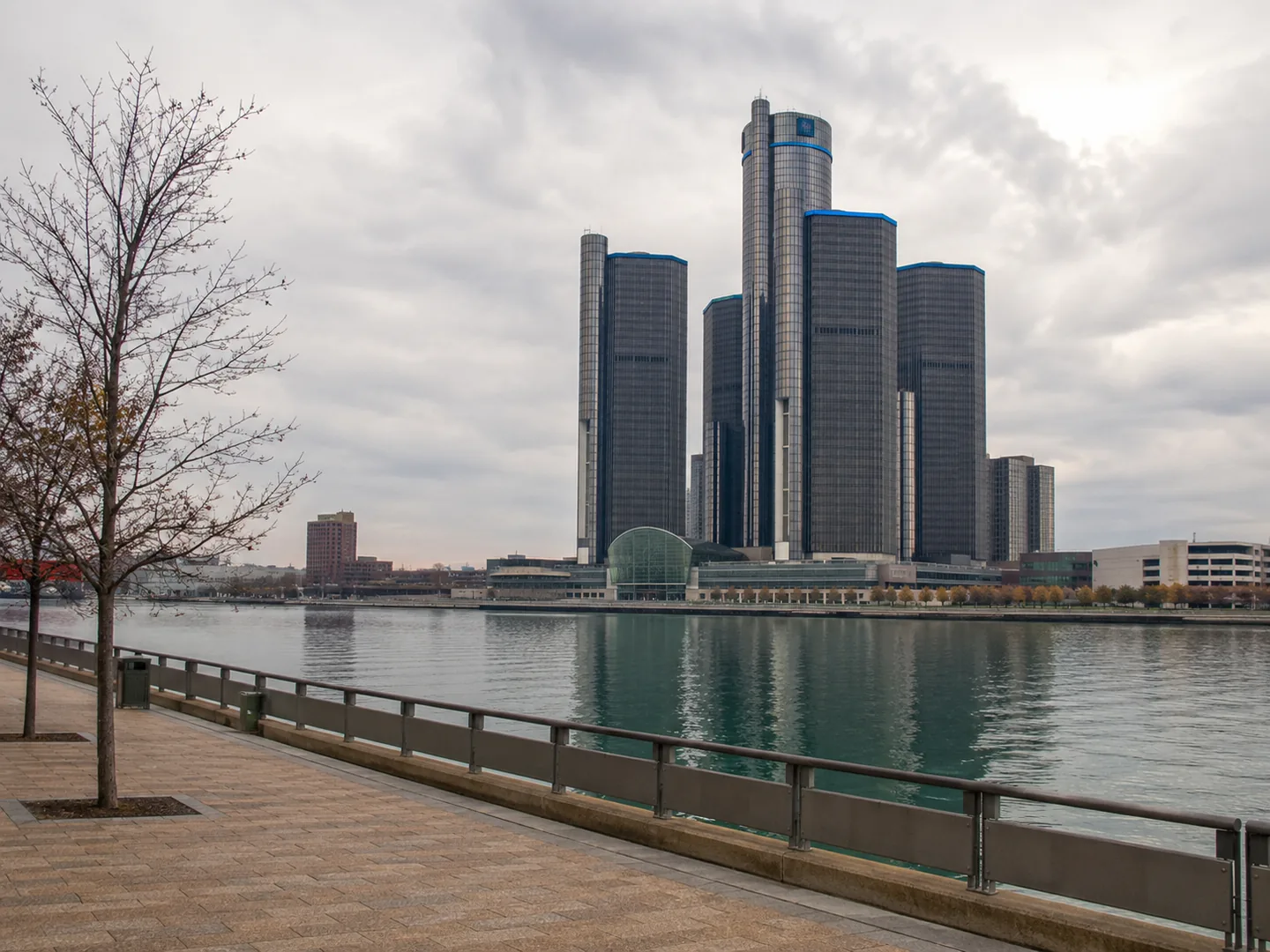
The Renaissance Center opened in 1976 and 1977 to a design by John Portman, the architect whose atrium hotels we wrote about in the FCRC 2027 Atlanta guide last week. It is seven connected towers: a 73-storey cylindrical hotel in the middle, four 39-storey office towers around it, and two shorter towers added in 1981.
It is also one of the most notorious wayfinding failures in American architecture. The original design prioritised secure, inward-facing interior space, and the result was a circular podium in which essentially nobody can find anything. This is not folklore. GM’s 2004 renovation added, among other things, a lighted glass walkway encircling the interior mezzanine specifically to help people navigate, roughly 660 feet around.
A building that needed a retrofitted circular guidance system so users could find the exit is hosting the ACM Symposium on User Interface Software and Technology. You will not need to invent an icebreaker.
The practical upshot: give yourself longer than you think to find your first session, and use the riverfront side as your orientation point rather than trying to hold the podium layout in your head.
You are seeing it in its current form for close to the last time
GM has moved its headquarters out of the Renaissance Center to the new Hudson’s Detroit development. A $1.6 billion redevelopment plan with Bedrock proposes demolishing towers 300 and 400, the two closest to the river, replacing the maze-like podium with public plazas that actually connect Jefferson Avenue to the Riverwalk, and converting remaining space to residential.
Demolition is slated to begin in April 2027, five months after UIST. The central hotel tower survives in the plan. The financing still depends on state approvals, so timelines may move, but if you have ever wanted to see the complete original RenCen, this is close to the last chance.
Where to stay
Distances are from the Renaissance Center. Detroit’s conference geography is easy: everything below is within about 1.1 km.
The venue itself. Detroit Marriott at the Renaissance Center (details) is the central tower, so your commute is a lift and you skip the podium navigation problem entirely. Given the room block has no published cut-off, this is the one to book first.
Closest alternatives. Courtyard by Marriott Detroit Downtown (details) is 268 m away on the riverfront. Atheneum Suite Hotel (details) at 610 m is all-suite and sits in Greektown, which is where you will end up eating anyway.
The restored buildings, which is what Detroit does best. Shinola Hotel (details) at 979 m is the flagship from the Detroit watch and bicycle brand and the obvious pick for a design-minded crowd. The Westin Book Cadillac (details) at 994 m is a 1924 landmark that sat derelict for two decades before restoration. The Siren Hotel (details) at 1.1 km occupies the 1926 Wurlitzer Building. Element Detroit at The Metropolitan (details) at 1.1 km is in the 1925 neo-Gothic Metropolitan Building, empty for over thirty years, and has kitchens in the rooms.
Value. Hilton Garden Inn Detroit Downtown (details) at 884 m near Greektown.
The full list is on the Detroit city page, and the block-versus-independent question is covered here.
Early November is cold
Detroit’s pleasant windows are May to June and September to October. UIST lands just past that: expect roughly 3 to 10C, grey skies and a real chance of the first snow. Nothing severe, but pack a proper coat rather than a jacket, and note that the walk from a Woodward Avenue hotel that looks trivial on a map is less appealing at 9pm in November.
The People Mover loop is free, covers the downtown core including a station at the Renaissance Center, and is the sensible way to avoid the cold walks.
Between sessions
The Detroit Institute of Arts holds one of the finest encyclopedic collections in the United States, and its centrepiece is Diego Rivera’s Detroit Industry Murals, twenty-seven panels wrapping an entire courtyard, painted in 1932 and 1933. For a conference audience that thinks about tools and making, it is the single most relevant thing in the city.
The Motown Museum is the house where Berry Gordy started the label, and it is small, packed and worth the trip up Grand Boulevard.
The Riverwalk runs directly past the venue along the Detroit River, and it is worth stepping outside for the geographic oddity alone: because of how the river bends, you are looking south at Canada. Windsor, Ontario is on the far bank.
For dinner, Greektown is closest to the venue, while Corktown around Michigan Avenue is where the more interesting restaurants have opened, near the restored Michigan Central Station.