

MICCAI 2026 Strasbourg: Travel Guide and Where to Stay
- Dates: September 27 - October 1, 2026
- Venue: Palais des Congres, Wacken district
- Airport: Strasbourg (SXB) or Frankfurt, Basel and Paris by train
- Booking: One hotel is near the venue. Everything else is 25 minutes away
- Downtime: Petite France, Alsace at harvest time, and a tram into Germany
MICCAI 2026 runs from 27 September to 1 October at the Palais des Congrès in Strasbourg. Medical Image Computing and Computer Assisted Intervention is the field’s flagship, CORE A, and it is one of the largest conferences we track by programme size: 58 workshops sit alongside the main track this year.
That number is the first thing to plan around, because it changes what “attending MICCAI” means.
The week is bigger than the conference. With 58 satellite events, a substantial part of the value is in the workshop and tutorial days rather than the main sessions. The list ranges from long-running technical workshops like CDMRI on computational diffusion MRI and iMIMIC on interpretability, through clinical specialisms like RHEUM-AI and PedAItrics, to the newer wave: MedAGI on medical artificial general intelligence, DT4H on digital twins for healthcare, and MI4MedFM on mechanistic interpretability for medical foundation models. AFRICAI and MIRASOL both focus on imaging AI in resource-constrained settings.
If your work sits in a niche, there is a decent chance a workshop exists for exactly it, and the room will be twenty people who care rather than four hundred who are passing through. Budget for the full five days rather than flying in for the main track.
Getting in
Strasbourg has its own airport (SXB) about 12 km south-west, but it is small and mostly serves French and a few European routes. Most international attendees will do better arriving by train.
The city is unusually well placed for it. Paris is 1 hour 45 by TGV, Frankfurt about two hours, Basel around ninety minutes, and Zurich and Munich are both reachable in under four. If you are flying long-haul, coming into Frankfurt, Paris Charles de Gaulle or Basel and taking the train is usually faster and less painful than connecting to SXB.
Gare de Strasbourg sits just west of the historic centre under its glass shell. From the station the tram gets you anywhere in the city in about fifteen minutes.
Where to stay
Distances are from the Palais des Congrès, which sits in the Wacken district north-east of the centre, next to the European Parliament.
The venue hotel, effectively. Hilton Strasbourg is 478 metres from the Palais des Congrès, a six minute walk, and it is the only hotel genuinely close to it. For a five-day conference with early workshop starts that is worth paying for, and it is the room block that goes first.
The historic centre. Everything else is on or beside the Grande Île, roughly 22 to 29 minutes on foot or a short tram ride. Sofitel Strasbourg Grande Île is the five-star option in the middle of the old town. Hôtel Régent Petite France & Spa occupies a converted ice factory on the water in the prettiest part of the city, with a spa, and is the one to pick if you are bringing someone or adding a weekend.
Mid-range and budget. Hôtel Hannong is a well-regarded three-star art deco hotel a few minutes from the cathedral. Ibis Strasbourg Centre Historique is the reliable budget choice, central and about 24 minutes from the venue.
Book early, and mean it. Strasbourg has fewer than 300,000 residents. A conference bringing several thousand people absorbs a real share of the city’s hotel stock, and unlike Paris or Munich there is no deep reserve to fall back on. The full list is on the Strasbourg city page, and we went through the block-versus-independent question here.
Germany is your backup plan
This is the thing most attendees do not know, and it is genuinely useful.
Tram line D crosses the Rhine into Kehl, Germany. It is an ordinary city tram on an ordinary ticket, around €1.80, running every 12 to 16 minutes on weekdays, and the trip from the middle of Strasbourg takes roughly 15 to 25 minutes depending where you board. The line has run to Kehl station since 2017 and to Kehl town hall since 2018.
Kehl is a small German border town with its own hotels, and during a large Strasbourg conference those hotels are frequently available and cheaper when the French side is not. You are commuting from another country, which sounds dramatic and is in practice a tram ride with no border check.
Worth knowing before you conclude the city is full.
Between sessions
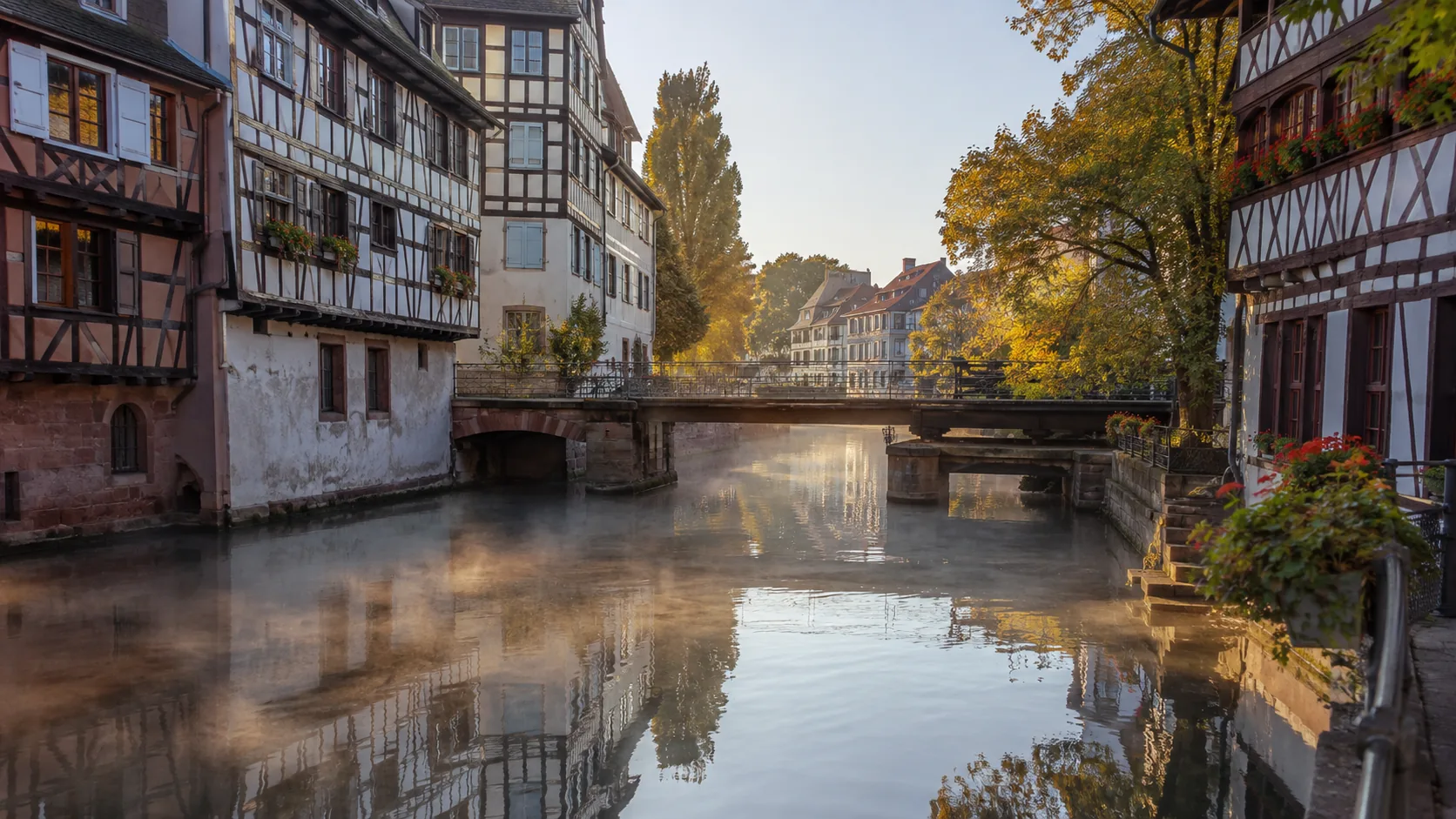
Petite France is the postcard: half-timbered houses along the canals in the south-west corner of the island, with the covered bridges and the Barrage Vauban terrace for the view back over them. It is genuinely lovely and genuinely crowded, so go early.
Strasbourg Cathedral is the one thing to make time for even if you make time for nothing else. It was the tallest building in the world for over two centuries, the sandstone facade is extraordinarily fine, and the astronomical clock still performs daily.
The European Parliament is a fifteen minute walk from the venue in the same Wacken district. You can visit when it is not in session, and the Parlamentarium Simone Veil is free.
Late September is harvest time in Alsace, which is the best possible accident of timing. The Route des Vins runs south from the city through Obernai, Ribeauvillé and Riquewihr, and a half-day out into the vineyards while the picking is happening is a better use of a free afternoon than another poster session. Colmar is 30 minutes by train.
And the food is Alsatian rather than French in the way you expect: tarte flambée, choucroute, and pinot gris and riesling rather than bordeaux. The winstubs in the old town are the place for it.
If you are presenting
MICCAI is large and the poster sessions are dense. Two practical notes.
The medical imaging community skews clinical as well as computational, so a meaningful share of your audience will care more about whether your method survives contact with real scanner data than about the architecture. Worth a slide.
And if you are earlier on and reading this because MICCAI is a target rather than a booking, it is one of the venues in the accessible band we mapped in our acceptance-rate analysis, and the workshops are a realistic first venue in their own right. Full details on the MICCAI conference page.