

The First-Time Academic Conference Attendee Guide
Academic conferences can feel disorienting the first time. The program is dense, the venue is large, the attendees all seem to know each other, and it’s not obvious how to get the most out of three days in an unfamiliar city. Here is what experienced attendees know that first-timers usually have to figure out the hard way.
Book your hotel the day registration opens
Conference hotels fill up within hours of the block opening, not days. The official hotel options tend to be priced reasonably and are chosen for proximity to the venue, often walkable or at most a short transit ride. If you wait a week after registration opens, you’ll likely be looking at a hotel twenty minutes away and paying more for the privilege.
If you miss the conference block, check WorkWander’s conference pages for curated hotel picks near each venue. Booking.com’s cancellation policies are generally flexible if you book early enough, so locking something in and cancelling if plans change is a reasonable strategy.
Read the program before you arrive
Download the schedule PDF and spend an hour with it before you fly. Most conference websites have a reasonable online schedule browser but they tend to break under conference wifi loads. The PDF will be more reliable on the day.
Pick two or three sessions per time block that you actually want to attend. If your area is well represented, you’ll have conflicts; that’s normal. Identify in advance which poster sessions cover your interests, because those are where most of the real conversations happen.
Also look up the authors of four or five papers you’re most interested in. Having a face and a name connected before you arrive makes it much easier to walk up and introduce yourself.
Workshops are underrated for first-timers
Most major conferences run co-located workshops, usually on the days before or after the main program. These tend to be smaller, more focused, and critically, much easier to talk to people at. The main track of a large conference can feel like a crowd; a 60-person workshop on a specific topic feels like a seminar where you actually know roughly who everyone is.
If your conference has workshops relevant to your research, seriously consider registering for one. The single-day investment often yields better conversations and connections than a full day in the main track.
The coffee break matters more than the talk before it
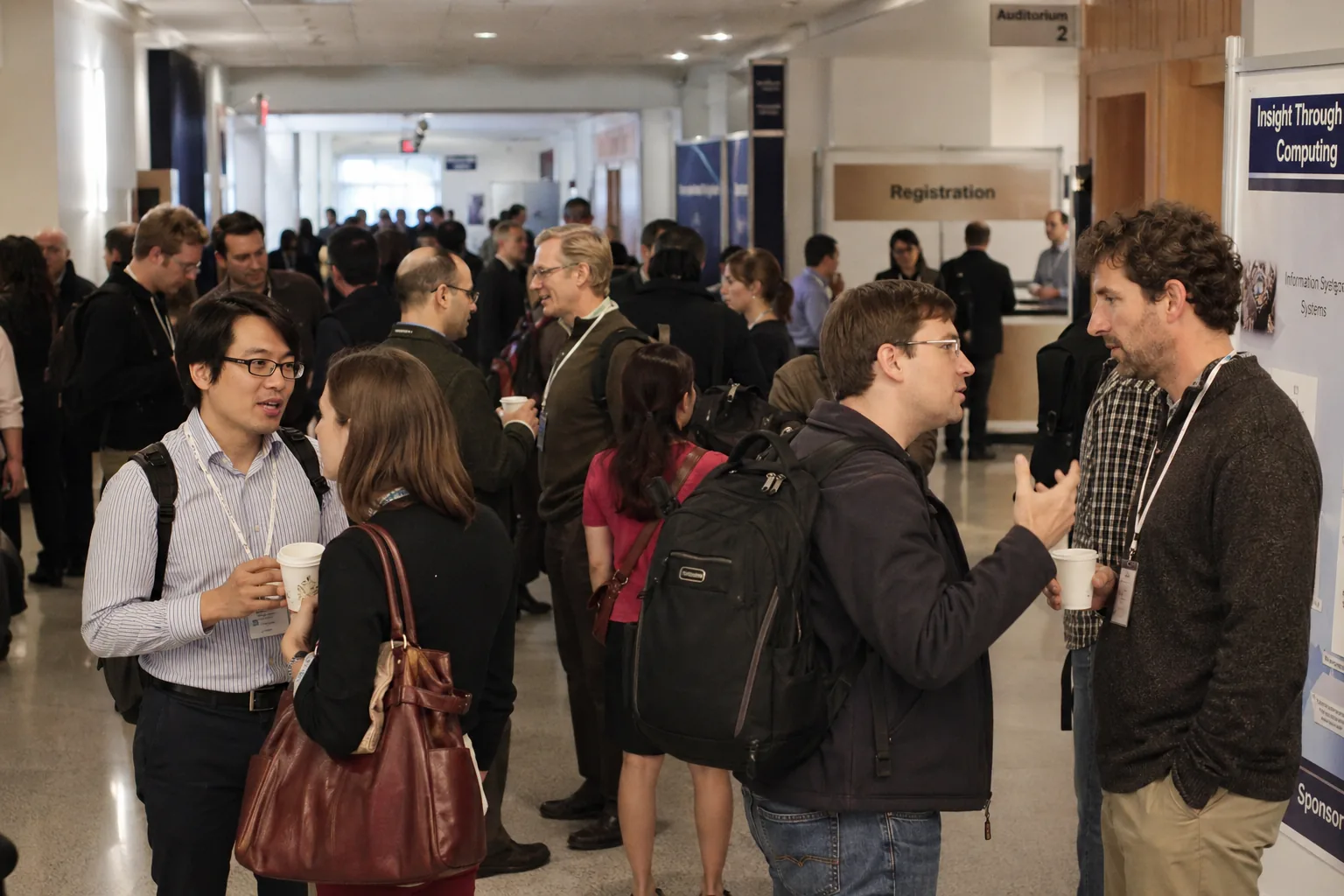
The formal program is not where the most valuable conversations happen. The ten-minute coffee break is. The lunch queue. The hallway outside a poster session. The bar the first evening.
The reason is simple: talks are one-to-many, breaks are one-to-one. Keynotes and paper presentations are useful for learning, but they don’t create relationships. The informal time does.
Don’t disappear to your hotel room between sessions. Even if you’re tired, staying in the common areas and being available for conversation is where the value accumulates.
How to actually talk to people
“I read your paper on X and had a question about Y” opens almost every conversation at a conference. It is specific, it is flattering in an earned way, and it gives the other person something concrete to respond to. You don’t need to have read the whole paper. A careful look at the abstract and the figures is enough to ask a genuine question.
If you don’t have a specific paper to reference, “what are you working on at the moment” is a reasonable opener, especially if someone is standing alone at a poster session or waiting for coffee. Most attendees are there to have conversations — you’re not interrupting.
Don’t try to collect contacts indiscriminately. Pick two or three people you genuinely want to follow up with and focus your energy on those conversations. A real exchange with three people is worth more than brief hellos with thirty.
At the poster session
Poster sessions are the primary networking venue at most CS conferences. If you’re presenting a poster, arrive ten minutes early to set up and be ready before the session officially opens. The first few minutes before the room gets crowded are often when the most senior people browse, and they’re less likely to stop when there’s a queue.
If you’re attending rather than presenting, work through the posters you identified in advance and don’t feel obligated to stop at every one. Reading the poster for ninety seconds before approaching the author lets you have a more specific conversation than walking up cold.
If you’re presenting a talk
Test your laptop connection at the break before your session, not when you’re called to the front. Most venues use HDMI or USB-C but adapters are not always available, so bring your own. Carry a PDF version of your slides on a USB drive as a backup.
Introduce yourself to the session chair before the session starts. It’s a small thing that most presenters skip, and it creates a warmer atmosphere when you’re introduced.
In the Q&A, you are allowed to say “I don’t know” or “we haven’t looked at that yet, but it’s an interesting direction.” You are not expected to have a complete answer to every question. Acknowledging a good challenge is more credible than improvising a weak answer.
After you’re home
The window for follow-up closes quickly. On the day you return, send LinkedIn or email connection requests with a short personal note while the conversations are fresh. “It was good talking about X at the poster session” is enough. A week later, the context has faded and the message feels generic.
If you promised to send someone a paper, a dataset, or an introduction, do it within two days. These small follow-throughs are how conference conversations become actual collaborations.
Browse upcoming conferences and find hotels at workwander.tech.